PoseAtlas
A Multi-View Synthetic Human Dataset with Geometrically Grounded Poses for 3D Pose Estimation
Abstract
Existing real-world human pose datasets provide limited diversity in identities, poses, and multi-view observations, constraining the variability available for training robust 2D and 3D pose estimation models. PoseAtlas addresses this challenge through a geometry-grounded synthetic human dataset generation pipeline that provides diverse identities with poses sampled from motion-capture data. Each identity is instantiated as a 3D avatar, posed and rendered from multiple calibrated viewpoints by a feed-forward human reconstruction model. The resulting renderings are refined by a dual spatial-control flow-matching model that improves visual realism while conditioning on projected avatar geometry and body-part segmentation. Reinforcement learning further promotes both pose consistency and perceptual quality. The generated dataset contains more than 1,000,000 images from 48K synthesized identities across eight calibrated viewpoints. Each image is paired with SMPL-X annotations derived directly from the underlying 3D geometry. Evaluation with independent 2D pose estimators demonstrates that the underlying geometry remains recoverable from the generated images, while training under the SMPLer-X benchmark protocol shows that PoseAtlas transfers as training data. PoseAtlas also achieves strong visual quality compared to other synthetic human datasets.
Generation Pipeline
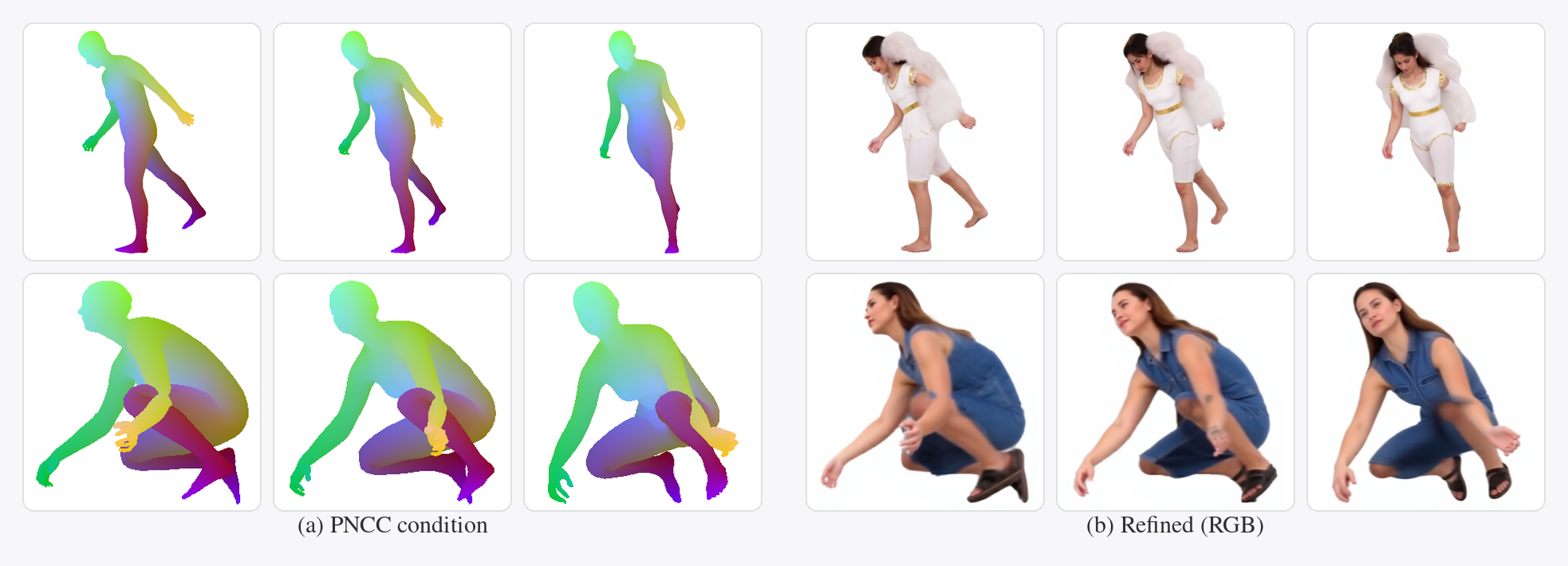
Calibrated multi-view PNCC geometry and refined RGB renders sharing a common 3D reference.
- Reference identity in canonical T-pose — a FLUX-based flow-matching generator synthesizes each identity from an attribute prompt (age, ethnicity, gender presentation, clothing, hairstyle, body shape), conditioned on a PNCC map of a canonical T-pose SMPL-X body.
- AMASS target pose sampling — target poses are sampled from the AMASS motion-capture archive and retargeted onto each identity's SMPL-X shape.
- Multi-view avatar rendering — a feed-forward avatar reconstruction model (LHM++) instantiates the posed identity as 3D Gaussians anchored to the canonical SMPL-X surface and renders it from multiple calibrated orbital viewpoints.
- Dual spatial-control refinement — a condition-injection flow-matching transformer refines each render, conditioned on PNCC geometry, body-part segmentation, and the attribute prompt, trained with a GRPO objective combining pose and preference rewards.
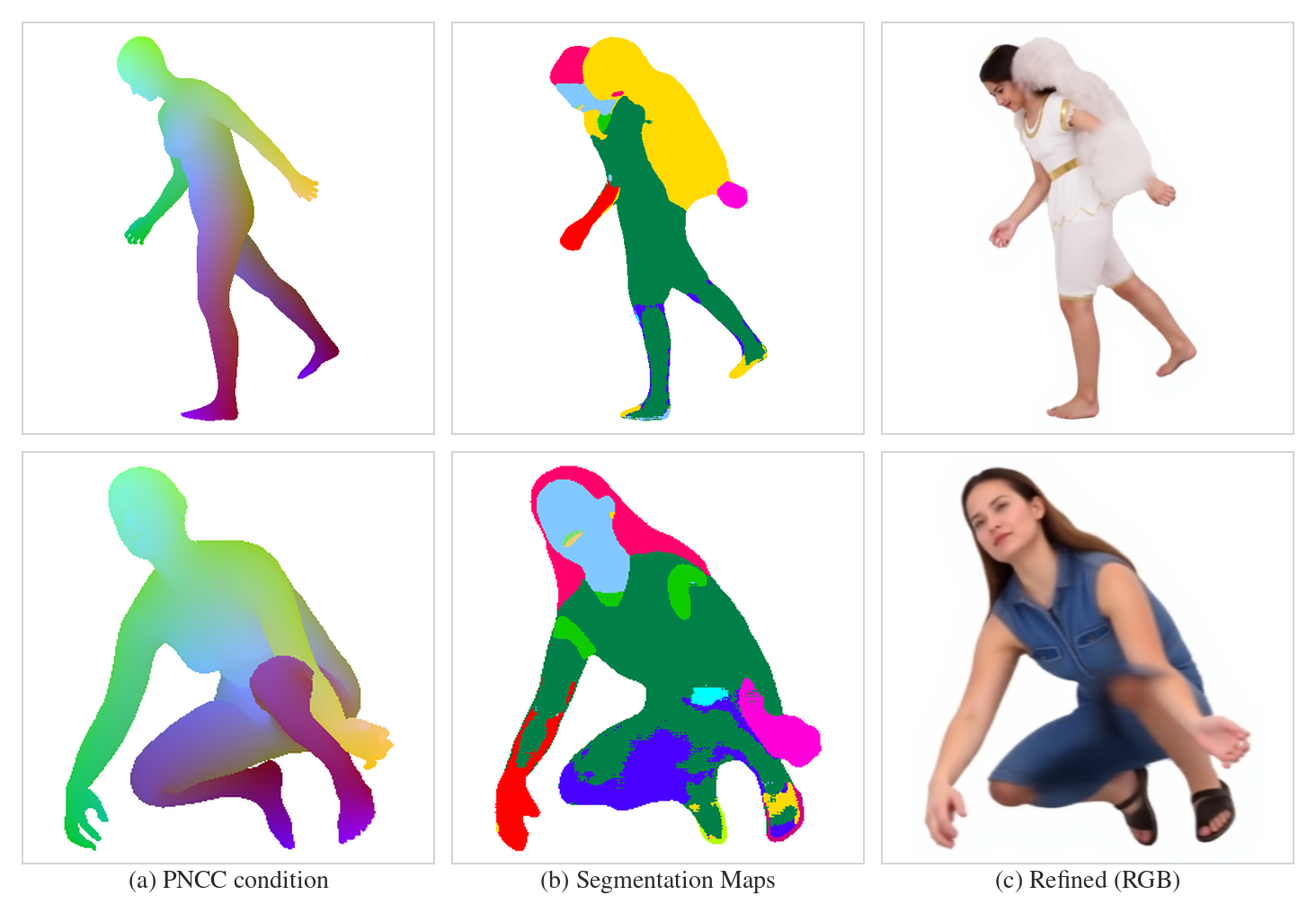
Dual spatial control: PNCC geometry + body-part segmentation condition the refinement stage.
Dataset Statistics
| Property | Value |
|---|---|
| Total images | 1,000,120 |
| Synthesized identities | 47,625 |
| Calibrated viewpoints per pose | 8 |
| Image resolution | 1024 × 2048 |
| Annotations | SMPL-X parameters + camera calibration, from 3D geometry |
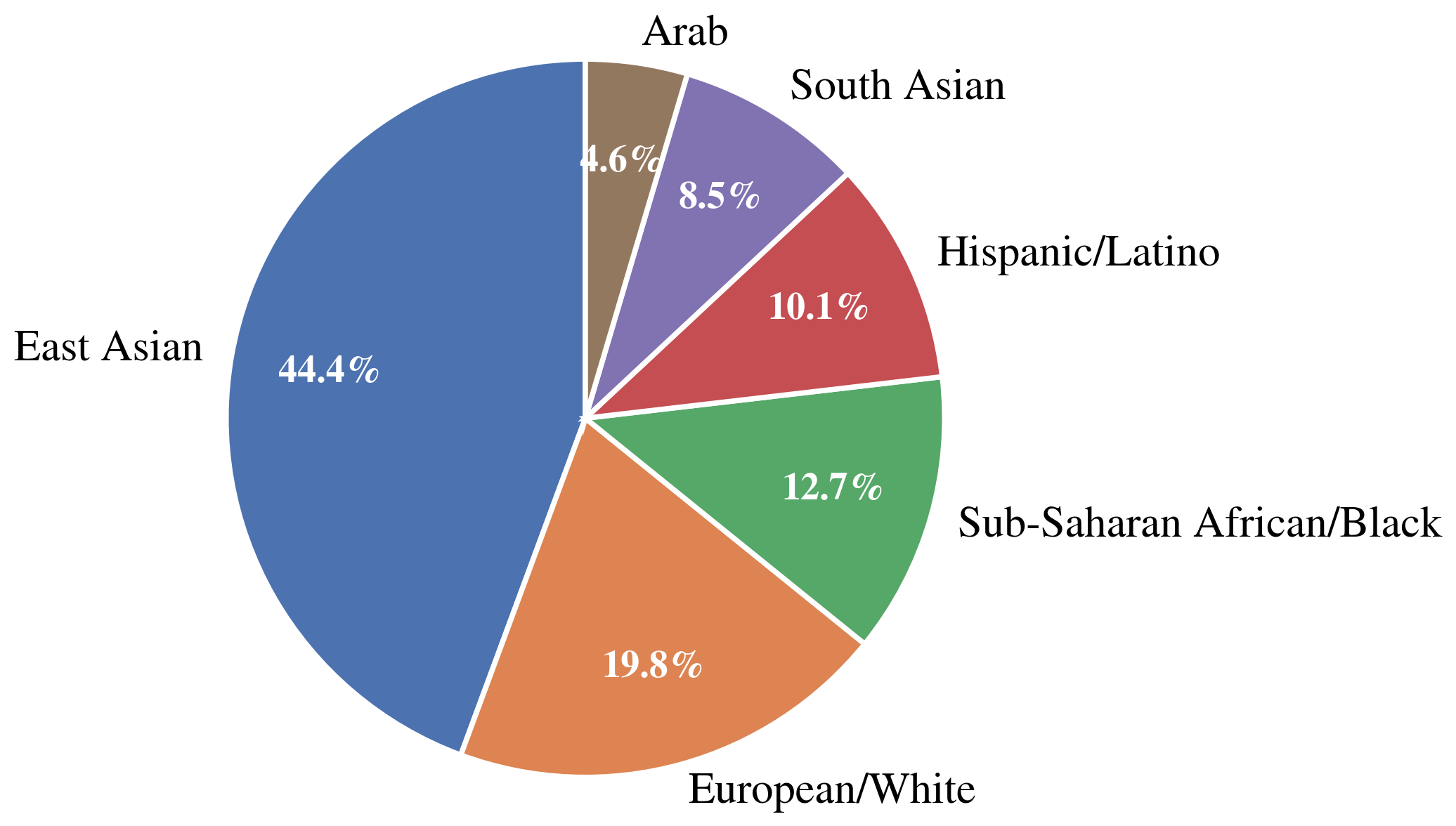
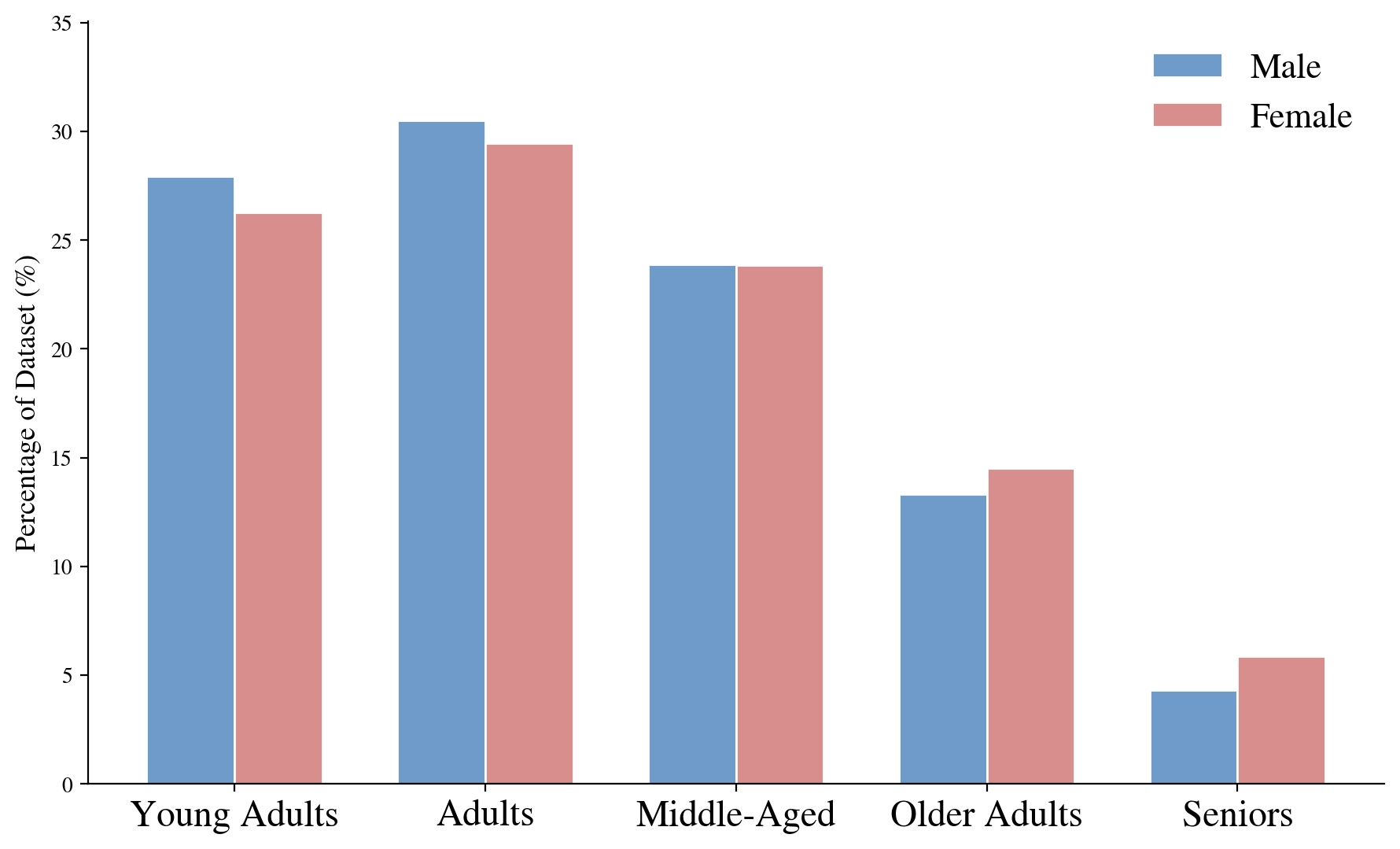
Identity diversity across the synthesized population (ethnicity, age).
Results
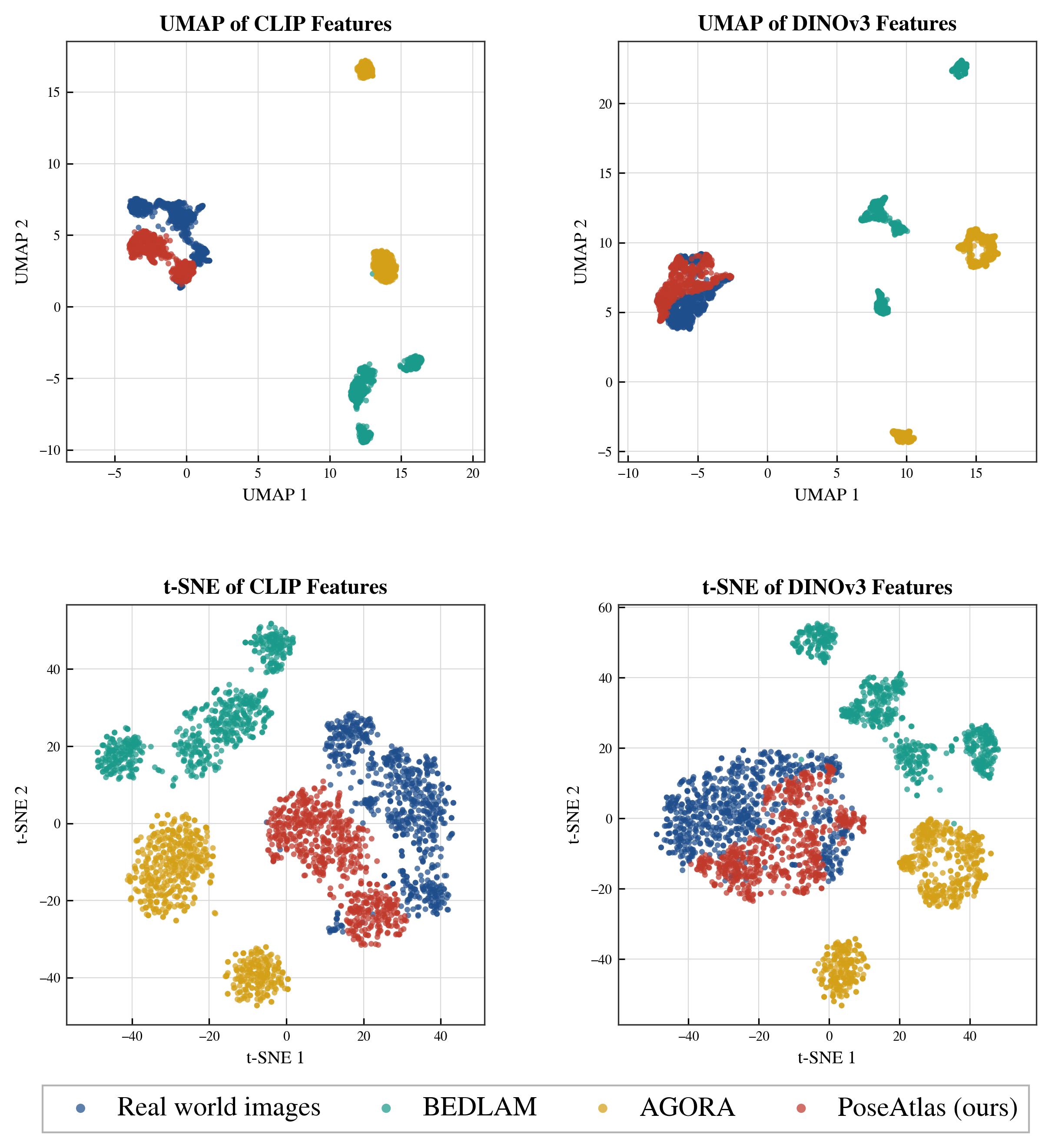
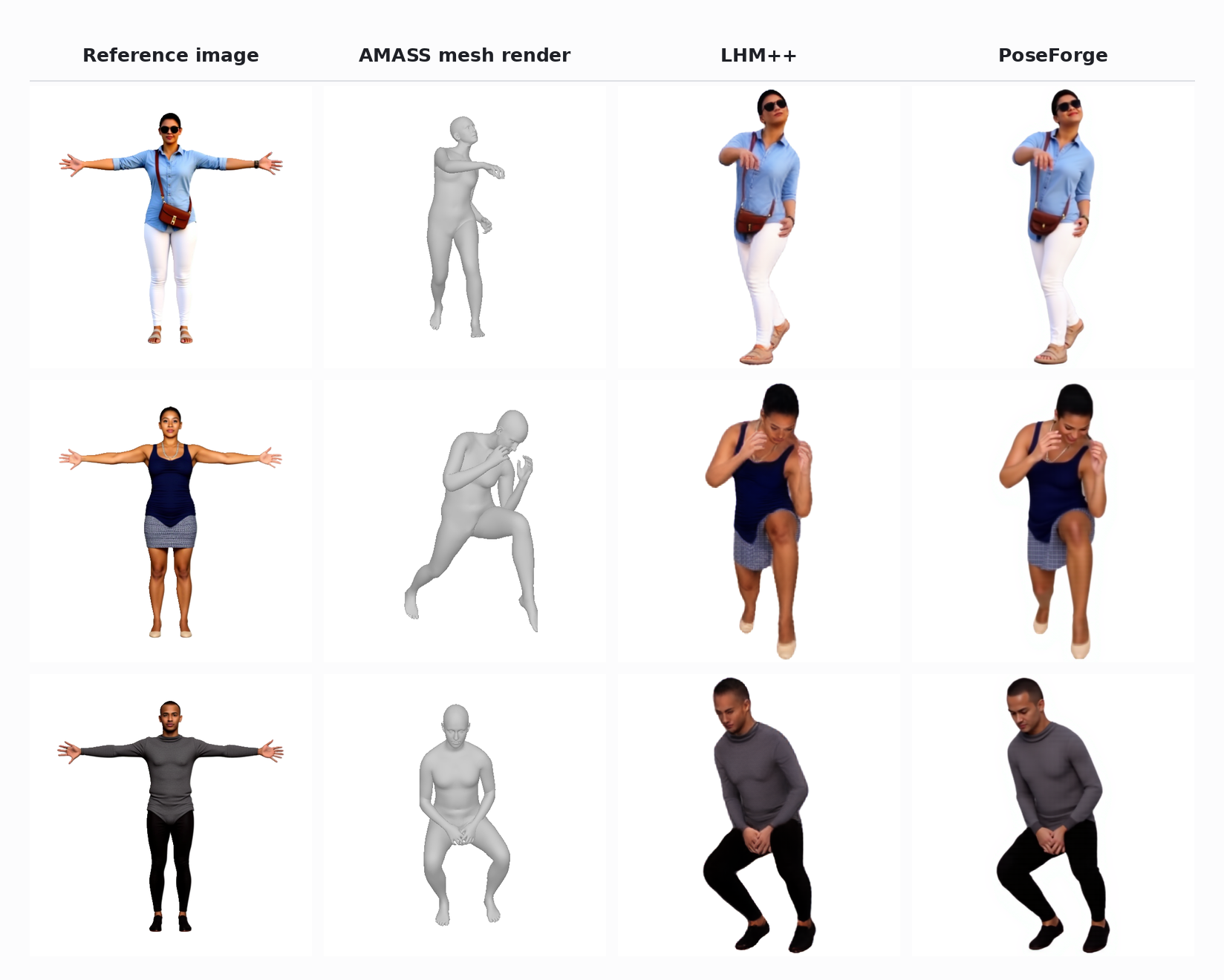
Visual comparison against existing synthetic human dataset baselines.
- 3D pose transfer (SMPLer-X protocol): training on a PoseAtlas + BEDLAM mixture (70/30) performs comparably to the strongest training mixtures on AGORA and 3DPW (within 0.3 mm of the lowest error), reaching 77.3 PVE / 107.1 MPE on EHF versus 78.7 / 108.3 for the closest alternative.
- 2D pose fidelity: independent 2D keypoint estimators recover the intended geometry with mean OKS ranging 0.528–0.798 (Sapiens-2B highest across all regions), evaluated against keypoints projected from the source SMPL-X geometry.
- Multi-view 3D consistency: MPJPE decreases consistently as views are added, reaching 24.2 mm with all 8 calibrated views.
- Visual quality: Inception Score 9.58, FID 1.82 — comparable to the strongest evaluated synthetic human dataset baseline.
Limitations
Fine-grained facial identity is less stable across views than body geometry, pose, and clothing, since body geometry is explicitly shared via SMPL-X while facial appearance is reconstructed independently per view. PoseAtlas currently focuses on single-person scenes and does not model multi-person interaction, overlap, or occlusion.
Data & Code
The PoseAtlas dataset and generation code will be released for non-commercial research use upon publication, including rendered images, SMPL-X parameters, camera parameters, identity/pose manifests, and an accompanying datasheet. This page will be updated with the dataset and repository links.
BibTeX
@inproceedings{poseatlas2027,
  title     = {PoseAtlas: A Multi-View Synthetic Human Dataset with Geometrically Grounded Poses for 3D Pose Estimation},
  author    = {PoseAtlas Authors},
  booktitle = {Proceedings of the IEEE/CVF Winter Conference on Applications of Computer Vision (WACV) Workshops},
  year      = {2027}
}